Types of Accessibility Issues
Disability is part of being human. Almost everyone will temporarily or permanently experience a disability at some point in their life. Over one billion people – about 15% of the global population – live with some form of disability, and this number is increasing.
Disability is not an edge case — it is part of the range of human experience. People interact with apps in many different ways depending on their abilities, the tools they use, and the situation they are in.
This includes permanent conditions (such as blindness or paralysis), temporary ones (such as a broken arm or eye surgery recovery), and situational challenges (such as using a phone one-handed while carrying something). Designing for accessibility benefits all of these people.
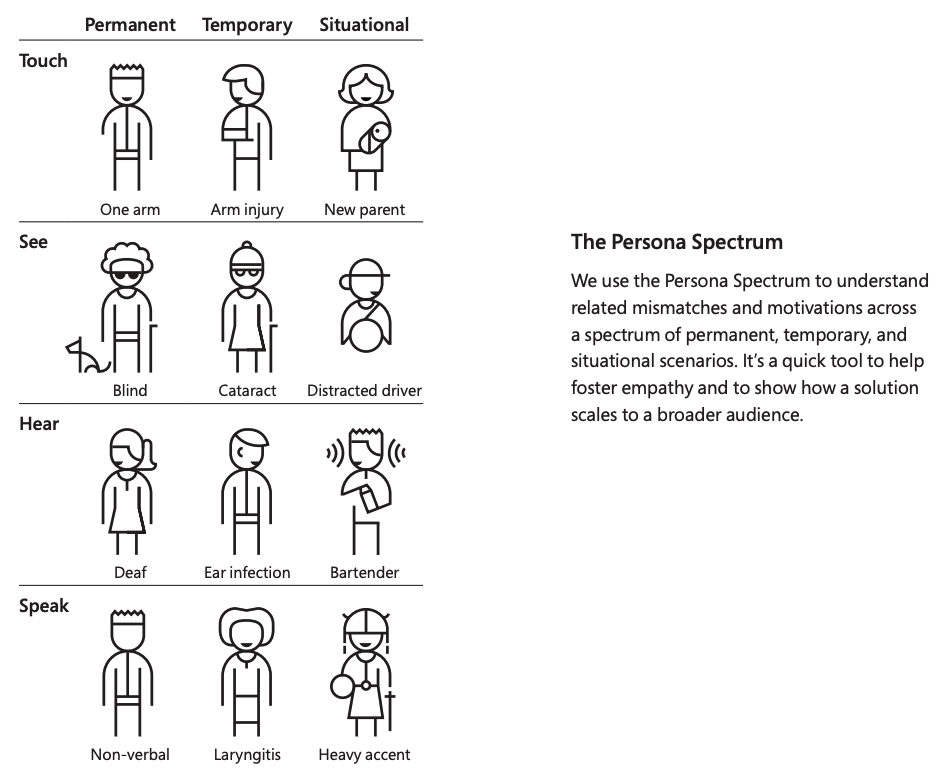
Disability: A Spectrum, Not a Binary
Disability is not a binary condition — it exists on a spectrum from mild to severe, with many variations and overlaps.
For example, hearing loss ranges from mild difficulty picking up certain sounds all the way to complete deafness. Visual impairment covers everything from slight blurring to no functional vision at all. Designing inclusively means accounting for this full range, not just the extremes.
Visual
Visual impairment is a reduction in vision that cannot be fully corrected with glasses or contact lenses.
Examples of visual impairments include:
- Visual Acuity (Clarity): The sharpness of vision, determining the ability to see details at near and far distances.
- Light Sensitivity: Difficulty or discomfort in bright light conditions or an increased sensitivity to light sources.
- Contrast Sensitivity: The ability to distinguish between variations of lightness and darkness, affecting the clarity of objects against their backgrounds.
- Field of Vision: The total area an individual can see without moving their eyes, including peripheral vision.
- Color Vision: The ability to perceive and distinguish between different colors — affected in conditions like color blindness.
Mobility
Mobility impairment refers to conditions that limit an individual's ability to move or coordinate certain movements. This ranges from challenges with fine motor skills, like grasping objects, to broader issues such as walking or controlling limbs.
Examples of mobility impairments:
- Tremor: Involuntary, rhythmic muscle contractions leading to shaking movements in one or more body parts.
- Lack of Coordination: Difficulty moving different body parts smoothly and efficiently together.
- Paralysis: Loss of muscle function in a body part, rendering it immobile.
- Amputation: The removal of a body part, especially a limb, either by surgery or trauma.
- Arthritis: Inflammation of the joints, causing pain and difficulty in movement.
Hearing
Hearing impairment refers to a reduced ability to hear, ranging from mild difficulties in picking up certain sounds to a complete loss of hearing.
Examples of hearing impairments:
- Hard of Hearing: Individuals who have some degree of hearing loss but may still retain some ability to hear, often requiring hearing aids or other assistive devices.
- Deafness: A more profound level of hearing loss where the individual has little to no functional hearing.
Cognitive
Cognitive impairment refers to challenges in mental processes such as memory, attention, learning, and decision-making. Individuals with cognitive impairments might find it difficult to remember information, grasp new concepts, maintain focus, or make decisions that affect their daily activities.
Examples of cognitive impairments:
- ADHD (Attention Deficit Hyperactivity Disorder): A neurodevelopmental disorder characterised by inattention, hyperactivity, and impulsivity.
- Autism: A developmental disorder affecting communication and behaviour, often characterised by challenges with social interactions and repetitive behaviours.
- Anxiety: A mental health disorder characterised by excessive fear, worry, or nervousness that can interfere with daily activities.
- Delirium: An abrupt change in the brain that causes confusion and reduced awareness of one's environment.
- Dyslexia: A learning disorder that affects the ability to read, write, and spell despite having average to above-average intelligence.
- Epilepsy: A neurological disorder marked by recurrent, unprovoked seizures.